Thermal Imaging for Electrical Panels: How Infrared Surveys Prevent Downtime and Fires
An infrared survey photographs the heat of your electrical system under load, finding loose terminations and overloads before they fail. Temperature rise over 15 °C above a similar component signals a defect needing urgent repair.
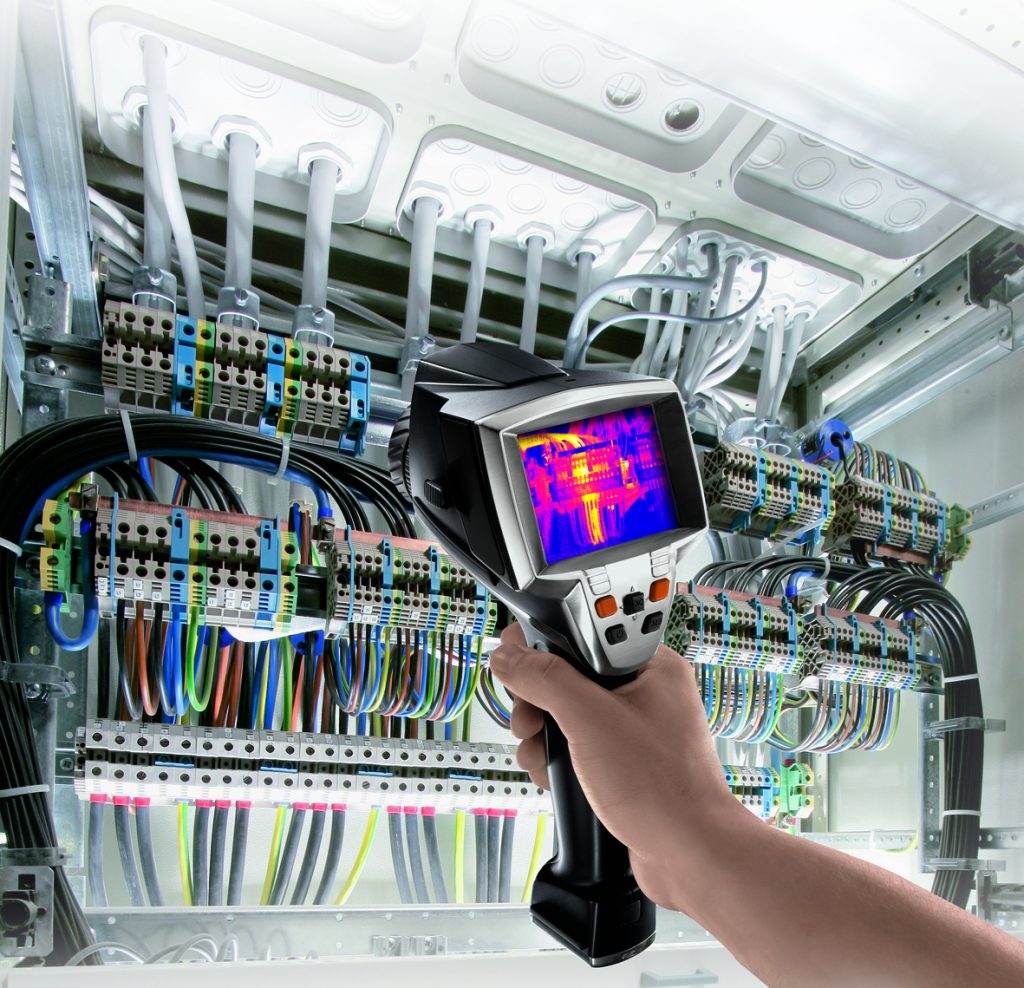
A thermal imaging survey photographs the heat signature of your electrical system while it runs. Electrical failures announce themselves thermally first: a loose termination, an overloaded phase, a failing breaker contact — each one heats up long before it burns, trips or welds shut. An infrared camera in trained hands finds these defects under load, without an outage, without touching anything — which is why thermography is the highest-return predictive maintenance task per hour spent on almost every industrial site we serve.
What does the camera actually find?
- Loose or corroded connections — the classic finding; resistance rises, the joint cooks, and eventually arcs.
- Phase imbalance and overload — one cable or busbar running visibly hotter than its siblings.
- Failing breakers and contactors — internal contact wear shows as heat at the terminals.
- Undersized conductors — uniformly hot runs that were sized for a smaller load than today’s.
- Blocked cooling — transformers and drive enclosures suffocating behind clogged filters (Saudi dust makes enclosure fans and filters a consumable, not a fit-and-forget item).
How hot is too hot? The delta-T severity scale
Absolute temperature matters less than the rise — ΔT — compared against a similar component under similar load, or against ambient. The thresholds used across the industry (aligned with NETA maintenance guidance):
| ΔT vs similar component | Severity | Action |
|---|---|---|
| 1–3 °C | Possible anomaly | Note and re-scan next survey |
| 4–15 °C | Probable defect | Repair at next planned outage |
| > 15 °C | Serious defect | Repair urgently — failure path established |
| > 40 °C vs ambient at a joint | Critical | Immediate action; fire risk is real |
Why do surveys matter more in Saudi conditions?
Three multipliers work against electrical equipment here. Ambient heat: a joint that would idle at 55 °C in a European plant starts its day at 45 °C ambient in Jubail — the margin to insulation damage is half. Dust: filters clog faster, cooling degrades faster, enclosures run hotter. Load factor: HVAC-driven summer demand keeps systems near maximum for months. The consequence is simple: survey intervals that pass in temperate climates are too long here. We recommend annual surveys as the floor, six-monthly for critical or dusty sites.
What must a professional thermographic report include?
A camera is not a survey. Insist on: paired infrared/visible photographs of every anomaly; the measured ΔT with load conditions recorded at the moment of capture (a 30%-loaded panel hides defects a 90% panel reveals); severity classification against a stated standard; location references your electricians can walk to; and a certified thermographer’s signature. That report format is exactly what our Thermography Electrical Inspections delivers — and each year’s survey baselines the next, so trends surface before failures do.
Where does thermography fit in a maintenance program?
It is the early-warning layer that directs the others. A hot joint found in the survey becomes a torque-check in the next shutdown; a hot transformer prompts oil analysis; repeated overload findings feed a load study. Combined with an EICR inspection every few years and protection testing at commissioning standard, it forms the measure-first maintenance loop that keeps unplanned downtime rare. Camera manufacturers publish good primers on technique — Fluke’s thermal imaging resources are a solid reference — but interpretation against load context is where engineering earns its keep.
Field notes: findings that paid for the survey many times over
Three patterns from our survey history illustrate why thermography earns its slot in every maintenance budget. In a Dammam logistics facility, a main incomer lug at ΔT +38 °C — invisible from outside a closed panel — was re-terminated in a planned 20-minute outage; left alone, the failure mode was a busbar fire in the main switchboard. In a Riyadh tower, one phase of a chiller feed ran 19 °C hotter than its siblings: a load-balance problem that was also costing energy, fixed by redistribution with no parts at all. And in a Jubail process plant, a transformer radiator bank showed a cold section — blocked internal circulation, caught long before winding temperatures suffered, and confirmed by the follow-up oil analysis. None of these appeared on any checklist; all of them appeared on camera.
Building thermography into your maintenance calendar
- Baseline first — the first survey maps normal; every later survey measures drift. Keep the images, not just the report.
- Survey at high load — schedule during production peaks or summer HVAC season; a lightly loaded defect is an invisible defect.
- Pair with corrective windows — book the survey 2–4 weeks before a planned shutdown so C-list repairs land in it.
- Include the forgotten assets — busduct runs, capacitor banks, UPS rooms, motor terminal boxes and enclosure cooling, not just the main boards.
- Re-scan after repairs — a re-terminated joint gets a confirmation image; that closes the loop and trains the trend.
Costed against a single avoided switchboard failure — equipment, downtime, and in the worst case fire damage — an annual survey program is one of the cheapest insurance policies in industrial maintenance.
How a Volt Solutions thermal survey runs, start to finish
Scoping needs only your board count and site layout; the quotation and survey plan come back within one business day. On the scheduled day — chosen for high load, because defects show under current — our thermographer works through the panel list with your permit system: covers opened by your electrician or ours, every board scanned and photographed in paired infrared/visible frames, load readings recorded at the moment of each capture so severity is judged in context. Critical findings do not wait for the report: anything at the urgent thresholds is flagged to your maintenance lead the same day, with the image in their hands before we leave site. The formal report follows within the week — findings classified on the ΔT scale, located on your single-line, and sequenced into a repair plan that separates ‘next shutdown’ from ‘this week’. Where clients want the loop closed, our team executes the re-terminations and re-scans each repair for a confirmation image. Year two is where the program compounds: the new survey overlays the baseline, trends emerge, and your maintenance planning shifts from reactive to scheduled — which is the entire point of predictive maintenance.
Frequently asked questions
Does the plant need to shut down for a survey?
The opposite — the survey needs the plant running, ideally above 40% load. Panel covers are removed under a permit; nothing is de-energised.
How long does a survey take?
Rule of thumb: 20–30 panels per day including documentation. A mid-size factory is typically one to two days on site, report within the week.
Infrared windows or open-panel scanning?
IR windows fitted to critical switchgear let routine scans happen closed-panel and arc-safe — a worthwhile retrofit for MV boards where opening covers requires an outage.
Volt Solutions’ thermographers survey facilities across Riyadh, Jeddah, Dammam, Jubail and Al-Khobar. Book a survey — one business day to a scoped quotation, and findings you can hand straight to your maintenance team.
Osama Khan
Power Systems Engineer at Volt Solutions. Osama leads power quality investigations, ETAP studies and electrical safety audits for industrial facilities across Saudi Arabia — Riyadh, Jeddah, Dammam and the Eastern Province.