What Is an ETAP Study? Meaning, Scope and Deliverables
An ETAP study is a computer model of your electrical network used to verify it is safe, stable and compliant — covering load flow, short circuit, arc flash and protection coordination.
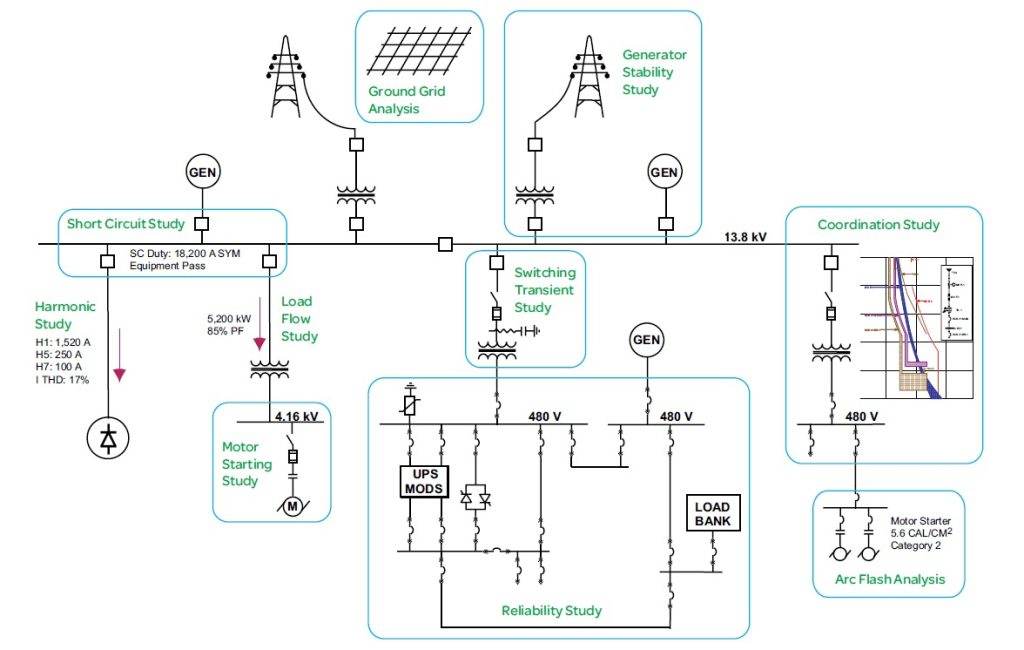
An ETAP study is an engineering analysis of your electrical network carried out in ETAP — the Electrical Transient Analyzer Program, the power system software most industrial plants and consultants standardise on. Your single-line diagram, cables, transformers, motors and protective devices are built into a computer model of the real installation, and that model is then used to answer questions you cannot safely answer by inspection: can the system carry its load, what happens during a fault, will the right breaker trip first, and how much arc-flash energy would reach someone standing at each panel.
The short version: it is the difference between believing your electrical system is safe and being able to prove it with numbers.
What ETAP actually is
ETAP is a modelling environment, not a measuring instrument. You give it the network — every bus, cable length and cross-section, transformer impedance, motor rating, breaker and relay type — and it solves the electrical behaviour of that network under conditions you specify. Nothing has to be energised or interrupted to run it.
That is also its limitation, and the reason studies go wrong. A model is only as good as the data behind it. Feed it nameplate assumptions and estimated cable lengths and it will return confident numbers describing a plant you do not own. This is why we build models from measured site data and a verified single-line diagram rather than from drawings that were last accurate three expansions ago.
The six analyses that make up a study
“An ETAP study” is shorthand for a set of analyses. Which ones you need depends on what you are trying to establish.
Load flow
Calculates voltage, current, power factor and losses at every point under normal running conditions. It answers whether your cables and transformers are within rating, where voltage is dropping below tolerance, and how much you are losing as heat. Load flow is where overloaded feeders show up before they announce themselves by failing.
Short circuit
Computes prospective fault current at every bus, typically to IEC 60909. The output matters for one blunt reason: a breaker whose breaking capacity is below the available fault current at its location will not clear a fault — it will fail, sometimes violently. Short circuit analysis is how you discover that a switchboard installed when the plant drew 800 kVA now sits on a supply capable of far more.
Protective device coordination
Plots the time-current curves of every protective device in series and tunes the settings so the device closest to a fault operates first. Done properly, a fault on one machine takes out that machine. Done badly — and it is done badly more often than not — a fault on one machine trips the incomer and stops the plant. Most of the plant-wide trips we are called in to investigate are coordination problems, not faults.
Arc flash
Calculates incident energy, in cal/cm², at each working position using the IEEE 1584 method, and from that the arc flash boundary and the PPE category a worker needs. This is what produces the warning labels on your panels. Under NFPA 70E the analysis behind those labels must be reviewed at intervals not exceeding five years, and whenever the installation changes in a way that affects it. A label from a study nobody has revisited since the last expansion is decoration, not protection.
Motor starting
Simulates the inrush of large motors to confirm they can start without pulling bus voltage down far enough to drop contactors or stall other machines. On a plant with a few large drives on a limited supply, this is the analysis that decides whether you need a soft starter, a variable frequency drive, or simply a different starting sequence.
Harmonic analysis
Models where distortion is generated and how it propagates, then checks the result against the limits in IEEE 519. It also catches the dangerous case: resonance between supply inductance and your own power factor capacitors, which amplifies a harmonic instead of absorbing it. The detail is in our separate write-up on harmonic distortion and IEEE 519.
When you need one
Four triggers cover most cases in Saudi industry:
- A new facility, or any significant expansion. Adding load changes fault levels and coordination everywhere upstream, not just at the new switchboard.
- A compliance or insurance requirement. Aramco and SEC-connected work, and most industrial insurers, expect a current study. So do many client pre-qualification processes.
- Unexplained trips or repeated equipment failures. If a breaker keeps operating and nobody can say why, the answer is usually in the coordination or the harmonic picture.
- Any arc-flash safety programme. You cannot label panels or specify PPE honestly without the incident-energy numbers.
Beyond those, the sensible rule is that the study is revisited whenever the network changes materially, and reviewed at least every five years regardless.
What we need from you to build the model
This is the part that determines how long a study takes, so it is worth knowing up front. To build an accurate model we need:
- The single-line diagram, as built — and an honest statement of how current it is
- Transformer details: rating, voltage ratios, impedance and vector group, from the nameplates
- Cable schedules: type, cross-section and actual route lengths. Estimated lengths are the most common single source of error in a short-circuit result
- Protective device data: make, model and settings of breakers and relays — the settings as they are now, not as they were designed
- Motor list: ratings, starting method, and which motors are genuinely large relative to the supply
- The utility fault level at your point of common coupling, from SEC
- Load measurements, which we take ourselves with Class A power analysers rather than working from connected ratings, because connected load and actual load are rarely the same number
Where the drawings and reality disagree — and they usually do — we walk the installation and verify. A study built on an out-of-date single-line diagram is worse than no study, because it produces labels and settings that people then trust.
What commonly turns up in Saudi plants
After enough of these, the findings repeat:
- Breakers under-rated for present fault levels, usually at sites that have expanded since the original design.
- No coordination at all between a main and its downstream devices, so any significant fault takes the whole board.
- Arc-flash energies far higher than expected at MCCs, driven by slow upstream clearing times rather than by large fault current. Reducing clearing time is often the cheapest safety improvement available.
- Capacitor banks installed without harmonic analysis, sitting near a resonance point and quietly shortening their own life and the transformer’s.
- Protection settings left at factory defaults, years after commissioning.
None of these are exotic. All of them are invisible until someone models the system.
What you receive
A study worth paying for ends in deliverables you can act on, not a PDF that restates your own drawings:
- The verified ETAP model itself, which becomes a plant asset — future changes get tested in software before they are made in copper
- A report with findings ranked by severity, with the measured and calculated values in it
- Updated protection settings, device by device, in a form your technicians can apply
- Arc-flash labels for every panel analysed, to IEEE 1584 and NFPA 70E
- A prioritised corrective action list that separates a safety problem from something merely untidy
Frequently asked questions
What does ETAP stand for?
Electrical Transient Analyzer Program. It is the name of the software; an ETAP study is a power system study carried out using it.
How long does an ETAP study take?
For a single-substation industrial facility with reasonable drawings, typically two to four weeks from site data collection to issued report. The variable is almost never the modelling — it is how accurate your existing documentation is, and how much of the installation we have to verify on foot.
Do we need a full study, or just arc flash?
Arc flash cannot be calculated on its own. Incident energy depends on fault current and on how fast the upstream device clears, so an arc-flash result needs a short-circuit study and device coordination data underneath it. Anyone offering arc-flash labels without those is guessing.
Is the study still valid after we add equipment?
Not for the parts of the network it affects. Adding load or changing a transformer alters fault levels and clearing times upstream, which changes incident energy and can invalidate labels. This is the advantage of keeping the model: an update costs far less than a new study.
Can you work from our existing single-line diagram?
We start from it, then verify it. If it has not been maintained through the last expansion we will say so before quoting, because that verification effort is the difference between a two-week job and a six-week one.
Does an ETAP study reduce our electricity bill?
Not directly — it is a safety and reliability exercise. But load flow routinely exposes losses and poor power factor, and acting on those does reduce the bill. If cost is your main driver, start with power quality analysis and power factor correction instead.
Volt Solutions delivers ETAP power system studies for industrial, commercial and utility clients across Saudi Arabia, built on measured site data rather than assumptions. Request a scoped quotation — we respond within one business day, or WhatsApp us on +966 59 996 4442.
Osama Khan
Power Systems Engineer at Volt Solutions. Osama leads power quality investigations, ETAP studies and electrical safety audits for industrial facilities across Saudi Arabia — Riyadh, Jeddah, Dammam and the Eastern Province.